
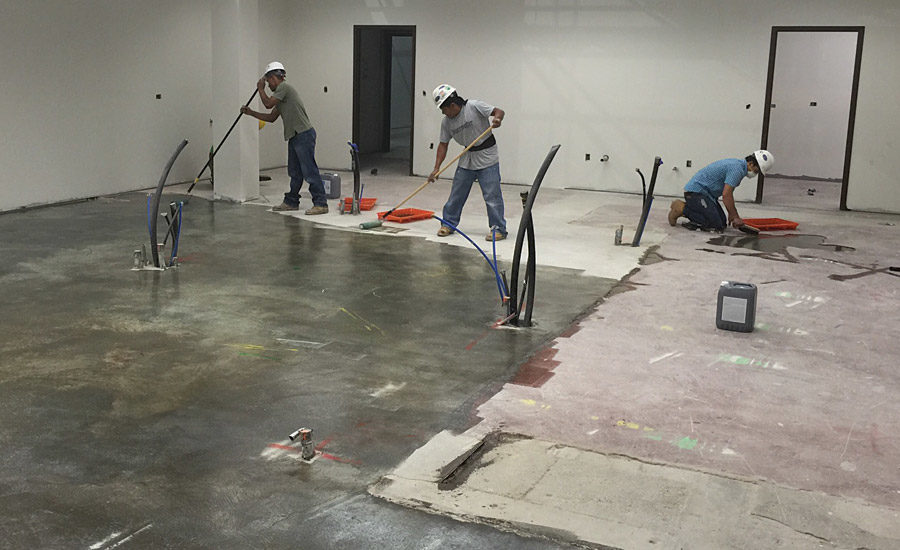
Imagine a freshly installed concrete floor covering. All the effort and investment to put a smooth and comfortable face on your concrete slab.
Then the next day, you find your new floor covered in bumps. You press a lump with your finger, and a yellow liquid oozes out.
That is what a floor covering failure looks like. You can avoid this hassle with concrete moisture testing.
If Concrete Is Hard, It Must Be Dry, Right?
Wrong! You can’t tell if a concrete slab is dry by looking at it. This assumption can be a costly mistake to make.
Concrete dries on the surface first, but there can still be plenty of moisture a few inches down, waiting to cause you headaches. Concrete is more porous than it looks, and the porosity allows moisture vapour to escape for the life of the concrete.
When you put a coating on concrete that is still releasing vapour, it traps the moisture. Then the vapour has to condense into a liquid to break through your floor covering and escape into the atmosphere.
What Do Concrete Moisture Tests Tell Me?
Concrete moisture tests tell you whether your slab is ready to have a covering installed. If you install a floor covering without a moisture test, you risk ruining all the work to install the flooring.
Moisture testing companies also tell you what floor covering type works best with your concrete. Each slab has a different chemical makeup, and there are floor coverings to match each.